Guide
Link analysis techniques: six ways to read a network
Six link analysis techniques investigators use most, from following the money to tracing the shortest path, each shown on a sample case you can open.
Link analysis is the work of finding out how people, companies, accounts, phones and events are connected. The techniques below are the moves analysts make over and over, whether they're working a fraud case, a money-laundering alert or a story. Each one is a question you ask the board, and each one is shown on Operation High Tide, the sample case that opens when you first load Minotrace. It runs in your browser, with no account.
If you're new to the idea, read Link analysis 101 first. It covers entities, links and why a graph beats a table. This post is the toolbox.
1. Follow the money
The question: where did the money come from, and where did it end up?
Start at the source and walk the transfers one account at a time, until the money stops or turns into cash. Three things are worth a second look: a payment split into smaller ones, money that returns to where it started, and a trail that ends in cash.
On the board: the Harbor Development Foundation pays NovaMar Consulting $1,240,000 in four installments. From NovaMar's account, three transfers of $49,500, $49,800 and $49,200 go to Richard Vance Pratt's account on March 12, 13 and 16, each just under $50,000, the kind of split that keeps every payment below a review or approval limit. That's a classic sign of structuring. A $210,000 payment goes to another person's account on April 2. Richard's account then shows a $96,000 cash withdrawal on April 14, and the sample marks it as not recovered.
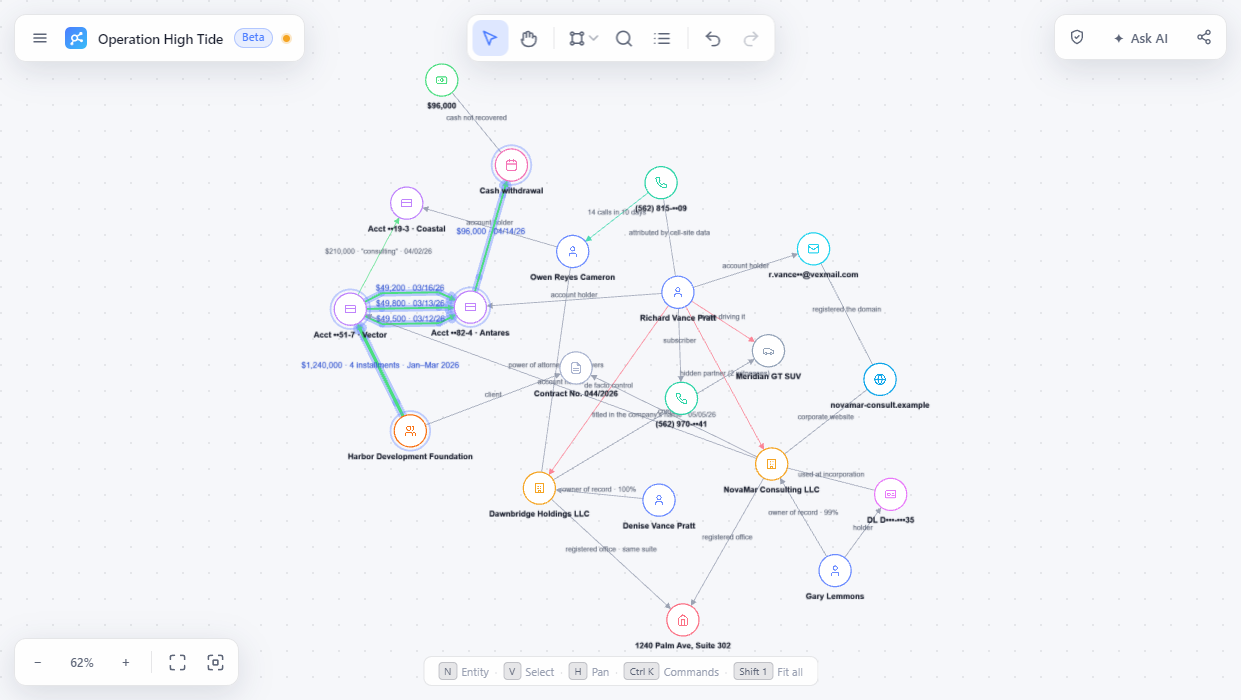
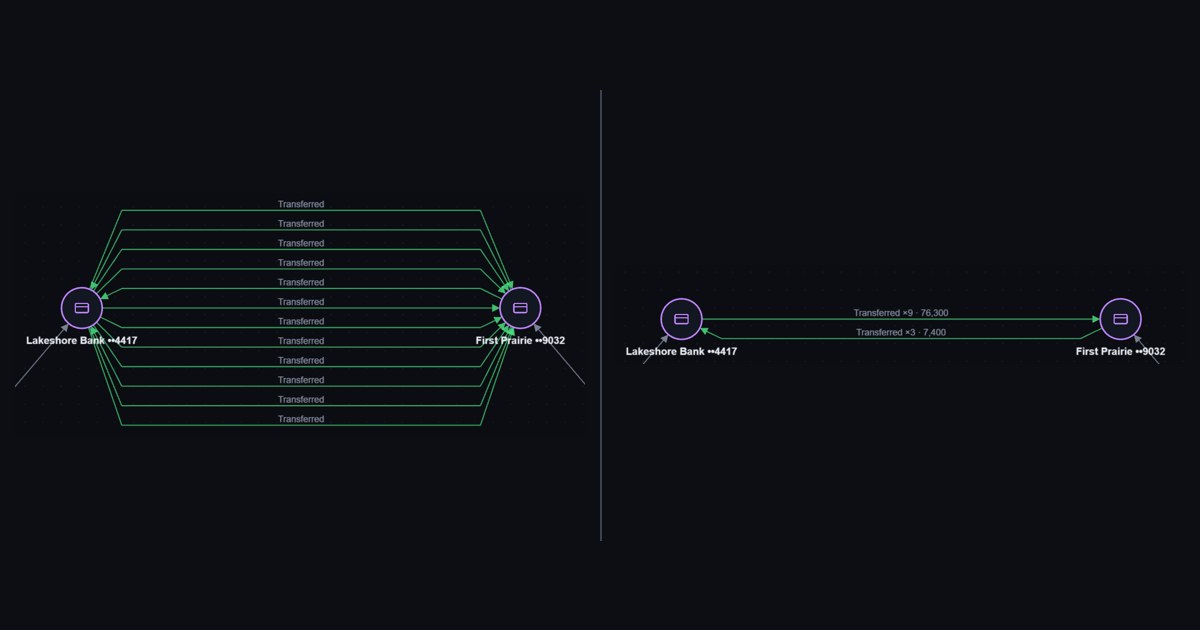
In Minotrace: a transfer is a link with an amount and a date, so you can click it and read it. When two accounts have dozens of transfers between them, group them into one line with a count and a total. The full walk is in Reading a money trail.
2. Find the hubs
The question: who or what has the most connections?
Count the links. The entity at the center is often the organizer, the front company or the shared account. A hub is a lead, not a verdict: a bank or a phone carrier is a hub in every case, so ask whether this entity has a reason to be at the center.
On the board: Richard Vance Pratt and NovaMar Consulting tie with seven links each. The next busiest is NovaMar's bank account, with six. The man at the center of the case and the company he secretly controls are the two busiest entities on the board.
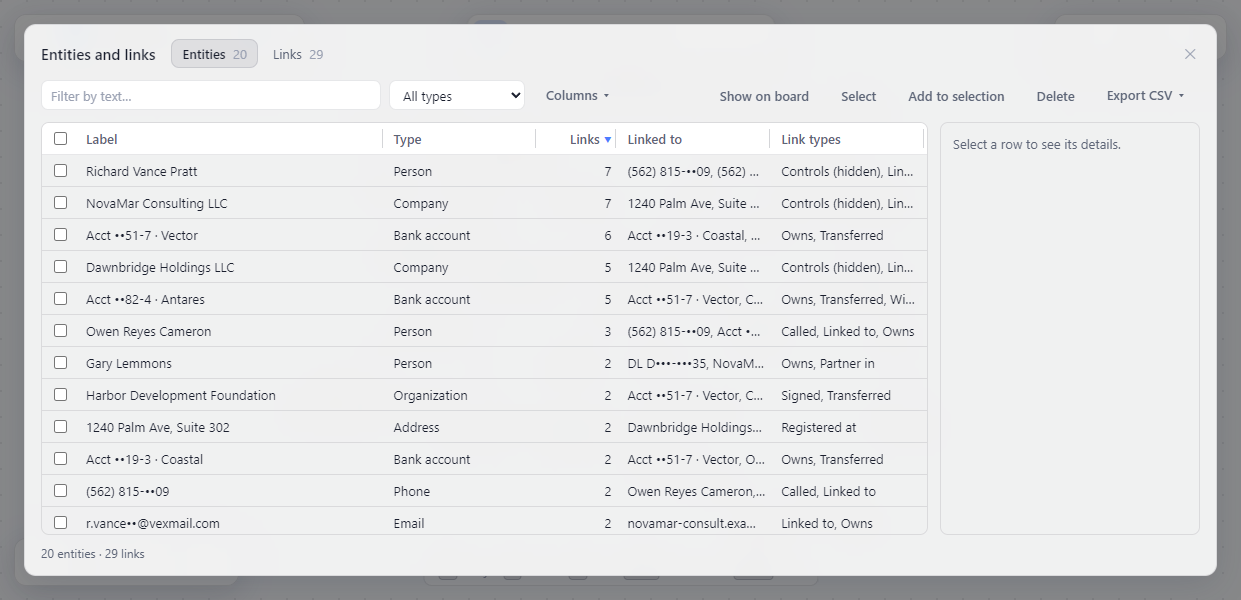
In Minotrace: open the List (Ctrl+Shift+L), sort by number of links, and filter by type to compare like with like. Or arrange with Force, where connected entities pull together and the hubs stand out. If you've connected the AI chat, you can also ask who is most connected.
3. Spot the clusters and the bridges
The question: who forms a group, and who connects two groups?
Most cases are several smaller groups that, on paper, have nothing to do with each other. The entity that sits between two of them is often the one who matters: an intermediary, a manager, someone who holds a power of attorney.
On the board: NovaMar and Dawnbridge Holdings are two companies with two different owners of record, Gary Lemmons and Denise Vance Pratt. What ties them together is Richard Vance Pratt, who controls both; the office suite they share; and Owen Reyes Cameron, who holds the power of attorney over Dawnbridge and received the $210,000 from NovaMar's account. Denise is Richard's sister. The sample records that on her card, not as a link, and a relative as the owner of record is exactly the kind of bridge this technique looks for.
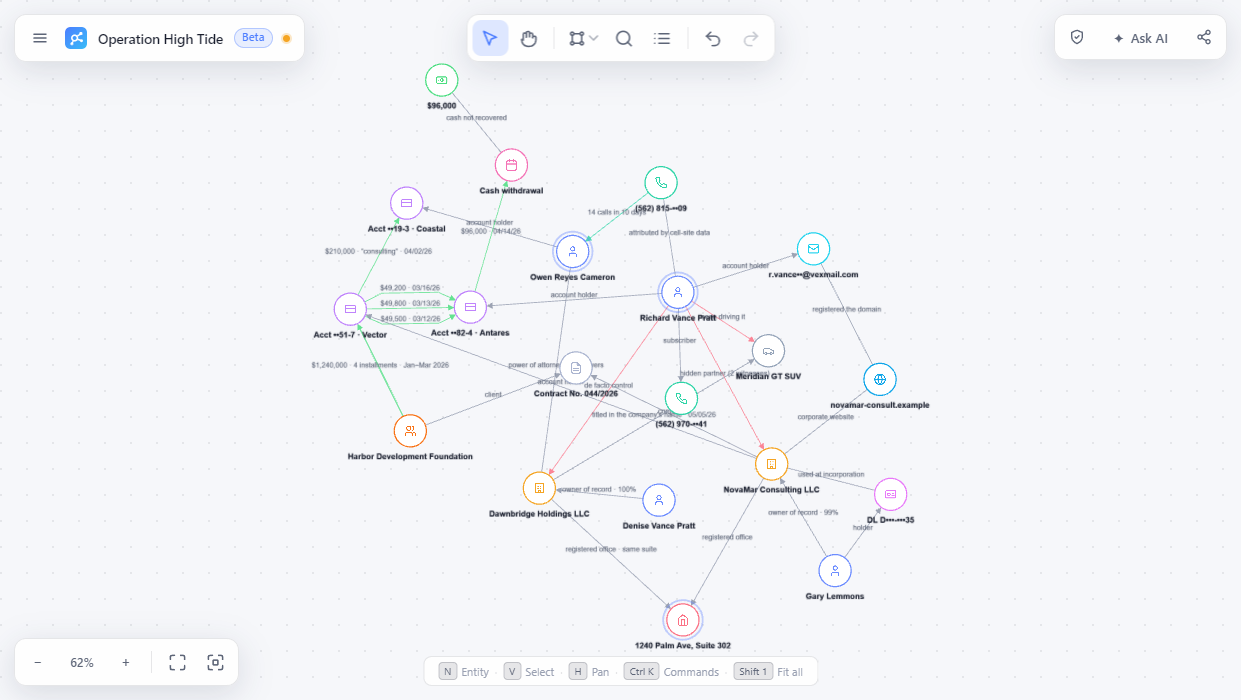
In Minotrace: Force shows the clusters and what sits between them. Circular groups puts each group on its own circle, so the links that cross from one group to another are easy to follow.
4. Catch the shared identifier
The question: what do these entities have in common that they shouldn't?
Different names, same phone. Different companies, same address. A phone, an address, a device or a document that shows up on entities that should have nothing to do with each other is one of the strongest signals in fraud work.
On the board: NovaMar and Dawnbridge are both registered at the same suite in Long Beach. A company that wins a $1,240,000 contract and a holding company have no reason to share a 130 sq ft office. On the board it is one address with two companies pointing at it.
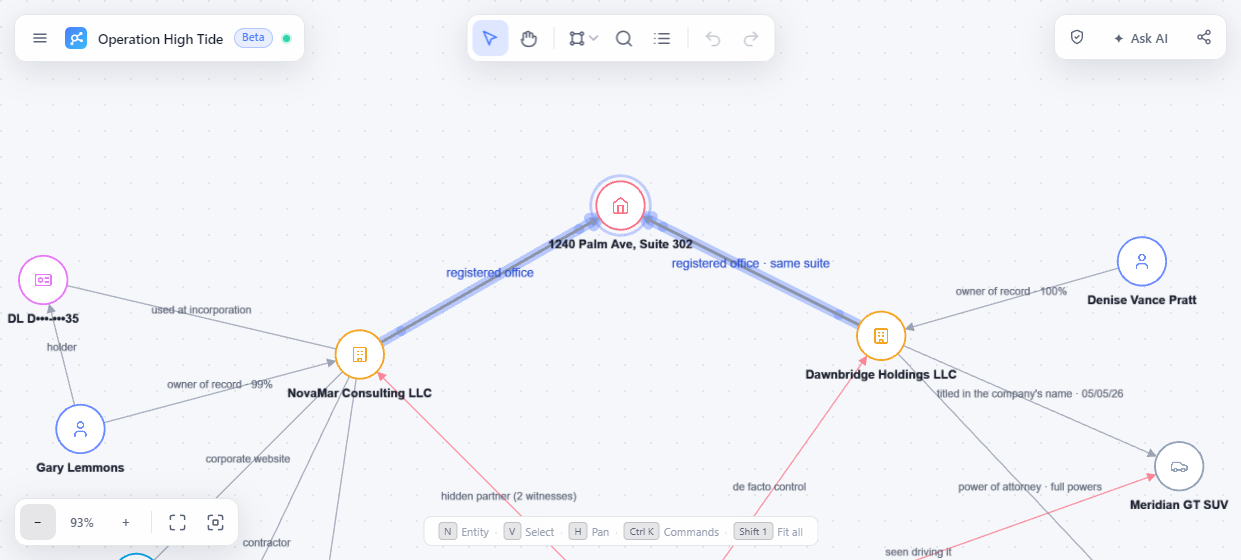
In Minotrace: this only works because of one rule: one real thing, one entity. The address is a single entity, so everything linked to it is visible at once. When you import a CSV, entities with the same type and the same key are merged for you. Then filter the List by type, say Address or Phone, and sort by number of links: anything linked to more than one entity deserves a look.
5. Trace the shortest path
The question: how are these two entities connected?
You suspect two people are related, but nothing connects them directly, and the board is too big to trace by eye. The shortest path is the chain of intermediaries between them: a company, a relative, a shared address, an account in the middle.
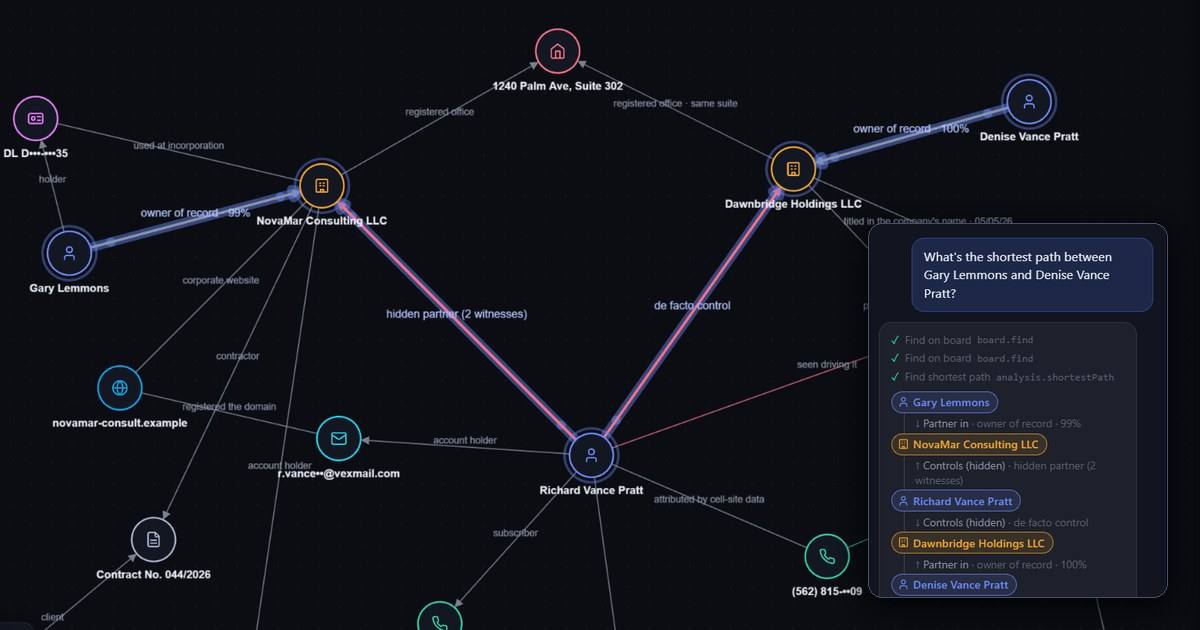
On the board: Gary Lemmons is the owner of record of NovaMar. Denise Vance Pratt is the owner of record of Dawnbridge. On paper, the two have nothing to do with each other. The shortest path between them is four links long, and there are two: through Richard, who controls both companies, or through the Long Beach suite where both companies are registered. Two front owners, two routes, and both run through the same setup.
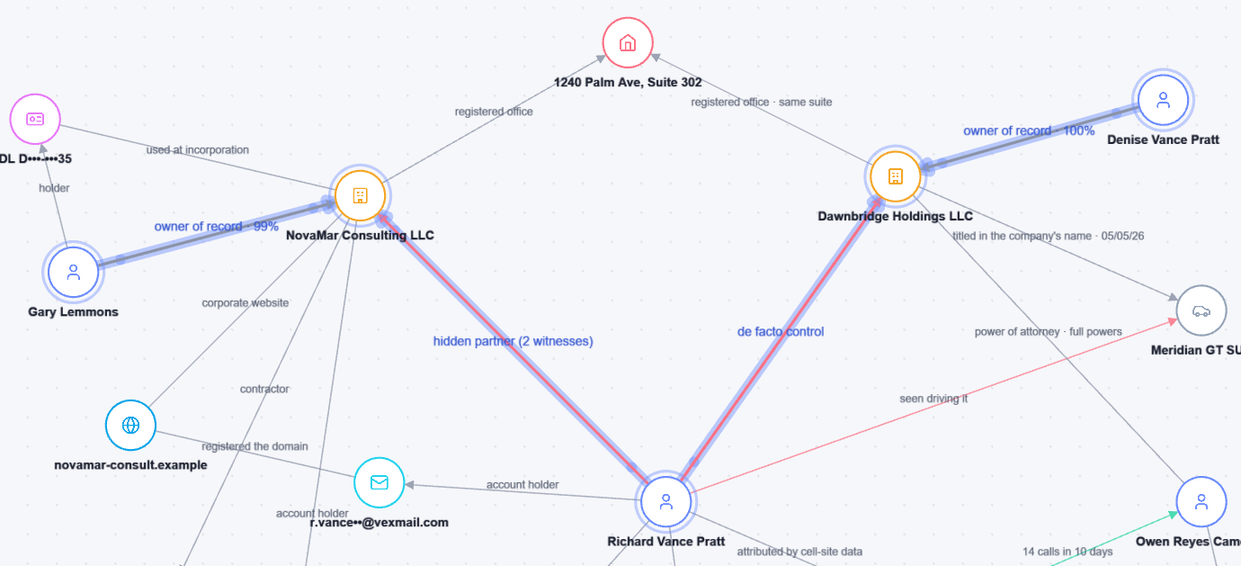
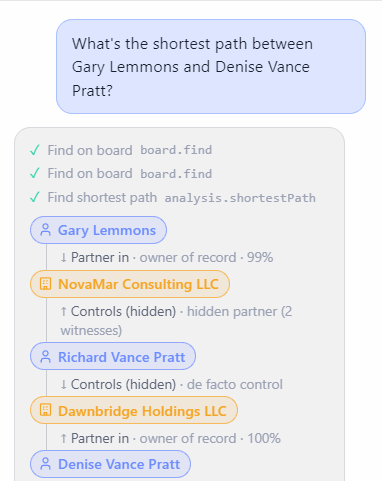
In Minotrace: this one needs the AI chat, which you connect with your own API key. Ask for the shortest path between two entities and it draws one on the board. When there's more than one, check the others by hand. The path ignores the direction of the links: here, the arrows point into and out of the companies, and the path still finds its way from one owner to the other.
6. Put events in order
The question: what happened first, and what happened right after?
Many cases only make sense in time. A company is incorporated, a contract is signed, the money moves and a phone goes quiet. Put the dates side by side and a sequence shows up that no single record gave you.
On the board: NovaMar was incorporated on November 18, 2025, and registered its website on December 2. Dawnbridge was incorporated on January 9, the contract was signed on January 22, the three transfers just under $50,000 happened between March 12 and 16, $210,000 went to Owen Reyes Cameron's account on April 2, and the cash was withdrawn on April 14. A prepaid phone attributed to Richard called Owen 14 times between March 5 and 14, in the week before and during the transfers. The same Owen received the $210,000 less than three weeks later.
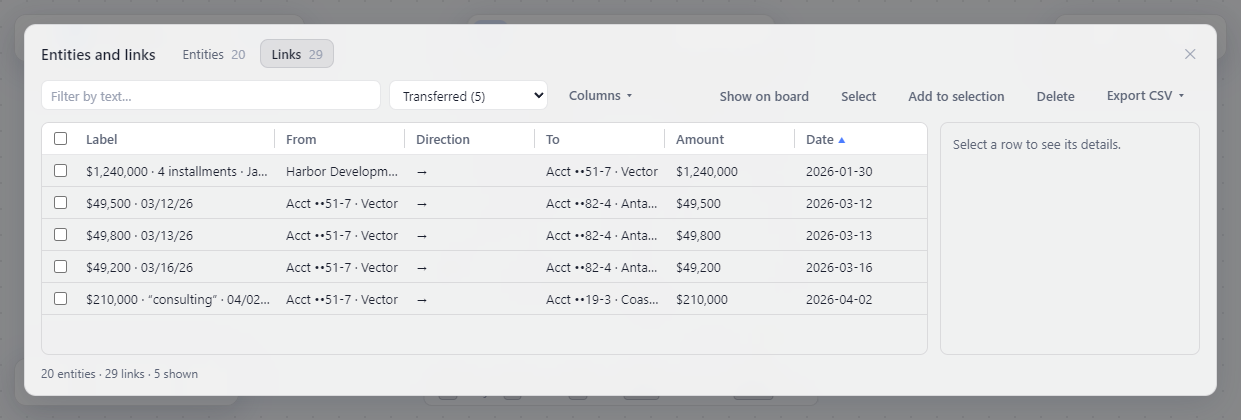
In Minotrace: arrange with Temporal and the entities that have a date line up in time order; Swimlane splits the same timeline into one lane per person or account. Temporal places entities, not links. Transfers are links with their own date: open the List (Ctrl+Shift+L), go to Links, filter by type, say Transferred, and sort by Date.
Which technique for which question
| You want to know | Start with |
|---|---|
| Where did the money go? | Follow the money: transfers, grouped with a count and a total |
| Who is at the center? | Hubs: the List sorted by number of links, or Force |
| Who connects two groups? | Bridges: Force or Circular groups |
| What do these have in common? | Shared identifiers: the List filtered by type |
| How are these two connected? | Shortest path, in the AI chat |
| What happened first? | Timeline: Temporal or Swimlane |
Search by pattern
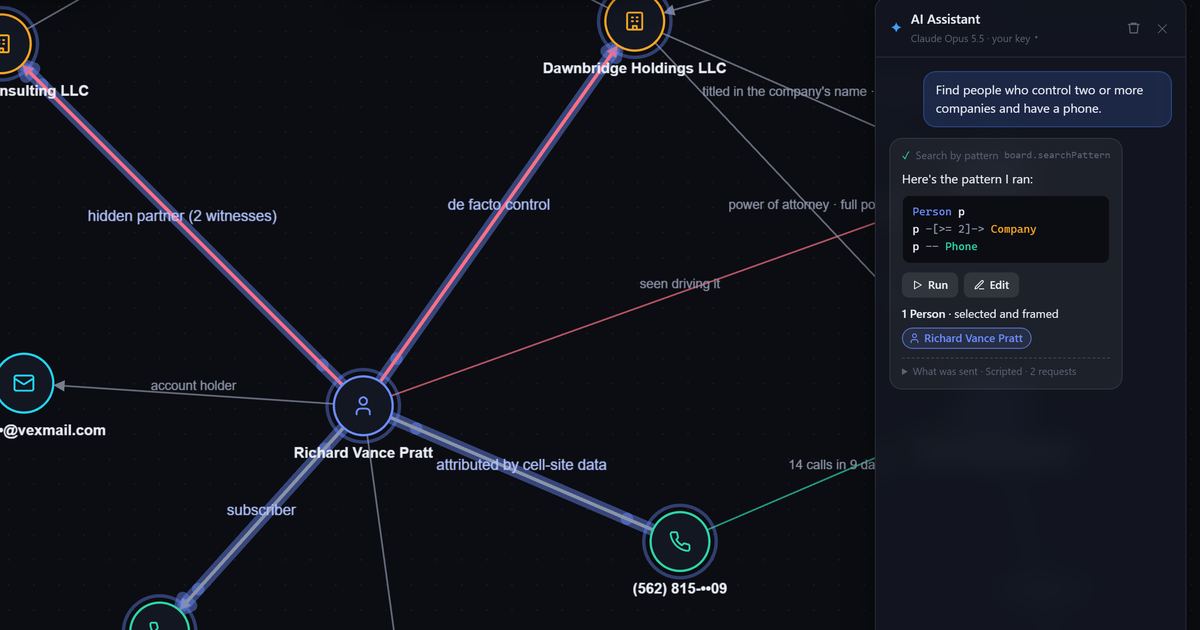
The techniques above start from a question you already have. When you know the shape you're after, ask for it: "people who control two or more companies and have a phone". The chat writes the search as a pattern you can read, edit and run again, and the AI never decides the result. Ask, check, run shows how.
Try them on a case
Open Minotrace and go through the six on Operation High Tide. It takes about ten minutes, and nothing leaves your browser, except what you send to the AI chat if you connect one. The guide lists every layout and the question each one answers.
Is there a technique you use that isn't here? Tell us.